Mass schedule
Find out about mass times in your parish.
Our Lady of the Assumption CATHEDRAL
Saint-Jean-Paul II Pastoral UnitFrench-speaking

Cathedrale.jpg
Priest in charge

SIMERVIL, P. Wislais, c.s.c.
Prêtre
Other members
D
DEJOUR, P. Modrince
Prêtre
Our Lady of the Assumption CATHEDRAL
Saint-Jean-Paul II Pastoral UnitFrench-speaking
Contact
Parish office
854, chemin Mountain, Moncton, NB E1C 2R8
Mass times
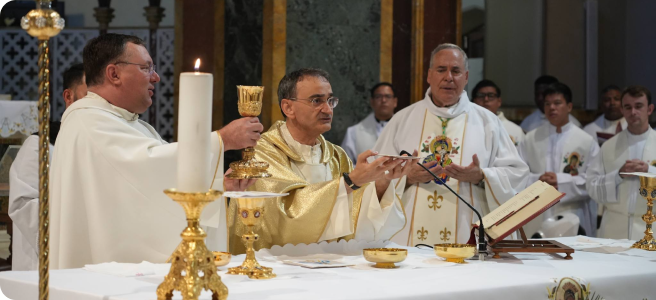
- Sunday11:00 AM
- Wednesday9:00 AM
Office hours
Monday to Thursday
8:30 a.m. to 12:30 p.m.
1 p.m. to 4 p.m.
Parish bulletins
Visit the parish website to view the latest parish newsletters.Visit the website
On the map
History
Established January 21, 1914
First church inaugurated March 21, 1915
First parish priest appointed January 22, 1914
Before the Great Upheaval of 1755, there was an Acadian mission at the bend of the Petitcodiac River at a place called La Chapelle (present-day Mascaret Park). This area, known as "Terre Rouge" (Red Land), was looted and burned during the Deportation.
Acadians settled in Moncton towards the end of the 19th century and attended Saint-Bernard Parish, founded in April 1879, which was officially bilingual.
As the Acadian population grew and became the majority in the parish, the Acadians requested a French-language parish. In 1914, the parish of Saint-Bernard was divided into two linguistic units. The first masses of the new parish of Notre-Dame de l’Assomption were celebrated alternately in the basement and the main nave of Saint-Bernard Church. In March 1915, the parish priest, the vicar, and the parishioners inaugurated the crypt, which would serve as the parish church of the Assumption until the construction of the cathedral in 1939. On February 22, 1937, Archbishop Arthur Melanson was installed there as the first Archbishop of Moncton.
The Cathedral of Notre-Dame de l’Assomption was inaugurated on November 21, 1940, in the presence of Cardinal Villeneuve, Primate of the Canadian Church and Archbishop of Quebec. The building is one of the most majestic in the city. Both its architecture and decoration are rich in works of art that reflect the life and faith of the Acadian people. Four white marble statues and two mosaics are the work of the Acadian artist Claude Roussel. The stained-glass windows in the cathedral's transepts evoke the religious and civic history of the Acadian people.
Bishop Melanson himself designated the new church as the Monument of Acadian Gratitude in homage to the Virgin Mary, patron saint of Acadia.
First church inaugurated March 21, 1915
First parish priest appointed January 22, 1914
Before the Great Upheaval of 1755, there was an Acadian mission at the bend of the Petitcodiac River at a place called La Chapelle (present-day Mascaret Park). This area, known as "Terre Rouge" (Red Land), was looted and burned during the Deportation.
Acadians settled in Moncton towards the end of the 19th century and attended Saint-Bernard Parish, founded in April 1879, which was officially bilingual.
As the Acadian population grew and became the majority in the parish, the Acadians requested a French-language parish. In 1914, the parish of Saint-Bernard was divided into two linguistic units. The first masses of the new parish of Notre-Dame de l’Assomption were celebrated alternately in the basement and the main nave of Saint-Bernard Church. In March 1915, the parish priest, the vicar, and the parishioners inaugurated the crypt, which would serve as the parish church of the Assumption until the construction of the cathedral in 1939. On February 22, 1937, Archbishop Arthur Melanson was installed there as the first Archbishop of Moncton.
The Cathedral of Notre-Dame de l’Assomption was inaugurated on November 21, 1940, in the presence of Cardinal Villeneuve, Primate of the Canadian Church and Archbishop of Quebec. The building is one of the most majestic in the city. Both its architecture and decoration are rich in works of art that reflect the life and faith of the Acadian people. Four white marble statues and two mosaics are the work of the Acadian artist Claude Roussel. The stained-glass windows in the cathedral's transepts evoke the religious and civic history of the Acadian people.
Bishop Melanson himself designated the new church as the Monument of Acadian Gratitude in homage to the Virgin Mary, patron saint of Acadia.